I would like to speak of a rare, inherited genetic disease that claimed the short lives of my two beautiful nieces, it is called Tay-Sachs disease. Tay-Sachs disease affects the central nervous system and is caused by not having enough or any of the enzyme called hexosaminidase A (HEX A). Within the lymosomes of our cells we are supposed to have HEX A. These special girls lacked that. HEX A is a protein that is necessary for breaking down GM2 gangliosides in nerve cells. Without HEX A they couldn't break down fatty substances in cells causing these fatty substances to build up and become toxic, slowly destroying brain cells until their nervous system stopped working.
Carlie (3/4/99-4/9/04)
My oldest niece was born what appeared to be a normal healthy little girl. At about 10 months old she started to experience what seemed to be a lazy eye and was taken to the optometrist. The optometrist found an abnormality called a cherry-red spot inside her eye. Cherry -red spots is a characteristic for Tay-Sachs disease. Carlie was diagnosed at 10 months old. After months of genetic testing they found that her mother and father were both carriers of the mutated gene. 1 in 300 people are carriers and 1 in 320,000 newborns are diagnosed in the United States. As Carlie got older her nerve cells became larger from the pressure of the fatty substances and mental and physical abilities became limited. At one point she was able to sit, crawl, and play like any other healthy child. Soon after her muscles began to stiffen, she was unable to swallow, her eyes drifted, she was startled easily, and she began to have seizures. Eventually as time went on she had no control over her body and became paralized. She had to have a feeding tube so she was able to get the proper nutrients and medicines she needed. Sadly heaven gained this beautiful angel at the young age of 5.
After suffering the loss of this beautiful angel, her parents were told when they went through the genetic testing that their chance of having another child with Tay-Sachs would be 25%. They decided to try again and she became pregnant. After conception about 5 weeks into the pregnancy testing began. Amniocentesis and chorionic villus sampling (CVS) were the names of the tests to be performed and this had to be repeated again at 13 weeks. Both times the test resultscame back inconclusive. On October 8, 2006 they gave birth to yet another beautiful little girl, Jasmine.
Jasmine (10/8/06-7/3/10)
At one day old blood was drawn and results indicated she too had the rare genetic disease, Tay-Sachs. Although her life was shorter than her sisters, she experienced the same exact symptoms as Carlie. She went to join her sister at just 3 1/2 years old.
The March of Dimes is a great organization for researching genetic diseases and offering support any way they can to families that suffer a loss or are pregnant. Please consider donating to the cause.
At this point, I would say basically everyone -- or at least the majority of people -- have been drug tested at some point in their lives. Whether this is was for a high school/college sport or for a job, drug tests are pretty common. Whenever word about an athletic drug test got out at my high school, a running joke among students was that all athletes should stay away from poppy seeds for a while in order to avoid their drug test producing a false negative.
As a former athlete myself, I was no stranger to the poppy seed joke, but I never fully understood why or how this random thing showed up in a test that was searching for drugs. It turns out that a handful of opiates -- codeine, morphine, and heroin -- are actually produced from the seeds of poppy flowers. All three of these opiates can be (and typically are) abused by some people. Therefore, ingesting poppy seeds can almost immediately lead to traces of opiates in the system, which can then be picked up by drug tests which are administered either in schools or in places of employment.
Poppy seeds are totally legal to be used in foods in the United States, but consumers should be aware of the repercussions of ingesting this ingredient. People who fall victim to a false negative drug test due to poppy seeds being in their system can opt for a more specific test (usually done on a hair follicle or through a blood sample) to prove that their system is clean of actual drugs.
Gene editing is now becoming one of the most debated and controversial scientific topics of our time. In April of this year, a group of scientists reported in the online journal of Protein and Cell that they had edited the human embryos using a gene editing technique called CRISPR. Gene editing can be done by this CRISPR system and makes it possible for nearly any scientist to edit DNA in nearly any cell. CRISPR includes a gene-shipping enzyme and a guide molecule that is programmed to focus on the unique DNA then will put the enzyme in the cell to cut and correct the gene that mutated or not healthy. Scientists have made steady progress in their ability to edit DNA, but the CRISPR system marks a major advance in this process. This system allows parents to ability to chose anything from their child's gender to what eye color or hair color they would like them to have. Many believe the process to be inhumane, manipulative, and just a way for wealthy or plain right greedy people to "engineer the perfect baby". Many experts say that use of CRISPR on human embryos should be put on hold until several ethical questions can be addressed. Such as, mistakes might occur in the editing process that could result in severe birth defects and other even successful edits could affect other parts of the genome that were meant to be left alone.
On the other hand though, many others believe that this process could be used for the common good of others. Interestingly enough, DNA editing could be a very positive and beneficial factor to our modern society. For example, many believe that gene editing could ultimately lead to producing children that are free of specific genes involved in inherited diseases. By editing the DNA of these specific cells or even the embryo itself, it may be possible to correct disease genes and pass those genetic fixes to future generations. Many researchers have used this system to modify certain genes to help restrain against specific diseases such as HIV, cystic fibrosis, down syndrome, and many more. Many others don't exactly see it that way though. They see it as a technical proposal to alter human heredity and consider it to be manipulative.
So what is the right answer? Unfortunately, so far there is no one correct answer but it will be a debate that will be among us for years to come. In the future, research of genome editing needs to focus on improving the safety of this process. Ultimately, right now, certain opinions do not seem to matter. If scientists figure out to do this in a way that's safe for patients, gene editing could produce tremendously beneficial medical treatments. Regardless, if it is found that the benefits seem to outweigh the risks, it is said that medicine will take this chance.
A mutually dependent
Relationship: Diabetes & Obesity
Obesity and Diabetes are pandemics
that are infiltrating into the world population at very alarming rates. Basically,
as per the indication from the Centre of Disease Control, a big portion of the
world population is living with obesity. For instance, statistical figures
reveal that, approximately seven percent of the American population is having
obesity, accounting for close to 59 million Americans something that has become
on the biggest challenge to community vitality. Statistics for the last decade
reveal that;
The rate of obesity has increased to 56 percent while diabetes has increased by
5 percent
The
future generation is likely to be immensely affected by diabetes
Basically, the risk factors for
both diabetes and obesity are linked to age, gender,
history of the family and race. However, it is important to understand that the
modern things we do now contribute immensely to the expansion if the two sicknesses.
The example of life style issues includes little or no physical exercise and
the like of food stuffs that have high fat contents.
These foods are
known to cause obesity, but the question remains; do the same foods cause
diabetes?
What is the connection between diabetes and obesity?
As it has always
been the case, is more often than not, most of the patients who are diagnosed
with diabetes as well have obesity. As a result of this observation, we can
comfortably tell that there must be a link between obesity and diabetes. So as
to prevent this disease in future times, it is critical that one should get
informed about the major causative factors.
When you are fat,
the body becomes very heavy. As a result, much of your weight will be exerted
on the body in many ways. One of the ways can be the inability of the body to
keep blood glucose level at optimal levels. As a matter of fact, a lot of body
mass resists against insulin thus the body does not utilize insulin well.
Basically, the form in which absorbed glucose is reserved is fat. The more
glucose is converted into fat results in addition of body mass, thus obesity.
It is important that, when on insulin intake, one should avoid taking a lot of
foods to prevent diabetes,http://www.joslin.org/info/why_did_i_gain_weight_when_i_started_taking_insulin.html.
Preventing obesity will prevent diabetes too
By virtue of the
causes diabetes and obesity, it is apparent that observing some basic lifestyle
issues will help reduce or treat the two diseases. These are very steps whose
impacts are far reaching. You need to do some physical exercise very day as
this will help extra fats in the body, eat a balanced diet; that is to mean
that the diets should have too much of fats and in some cases, use vitamin
supplements tailored to diabetic patients.
In some cases, the
patient could be obese. As such , it is highly recommended that one looses a
bit of their weight which will in turn lower the risks of diabetes. Weight loss
can be difficult but the following components of diet can quicken up the
process; low levels of carbohydrates, high fiber content coupled with a workout
plan.
Two days ago on June 12, 2015, the United States government
is now considering chimpanzees used for research as an endangered species through
the Endangered Species Act. This means that researchers cannot use chimps for
medical experiments as freely as they have before. Before this adjustment, “The United States is the
only major country that still funds invasive chimpanzee research,” according to
Nature Publishing Group. The only way that chimpanzees can be used now
is if the person has a permit from the U.S. Fish and Wildlife Service. Many
regulations for research using chimp have been made such as “work enhances the
survival of the species and benefits chimps in the wild”, if the chimp
is being used for human purposes it must be crucial to a human disease, the
researcher must somehow support chimpanzee preservation, and follow standard
research protocol such as applying for project approval and undergoing
inspections (AAAS).
This
change has affected many different people in positive and negative ways. For
animal rights groups and specific chimpanzee groups like the Jane Goodall Institute,
it is a huge success for something they have been working towards for many
years. The director of the U.S. Fish and Wildlife Service was quoted at the
press conference announcing this decision, “This decision will help us ensure that the world we pass
along to our children and grandchildren will be filled with chimpanzees. We
believe this action will ensure that activities affecting all chimpanzees will
contribute to the survival of chimpanzees in the wild,” (AAAS). The chimps
being released from laboratories will be sent to available sanctuaries since
there is no possible way of letting them go into the wild.
For laboratories using
chimpanzees for research, this modification will somewhat affect their work. If
they wish to continue using chimps they have to apply for strict permits and be
subject to more inspections, as well as supply some type of funding to protect
wild chimpanzees. An anatomist at Stony Brook University, Susan Larson, was quoted, “This is going
to make it increasingly difficult to get these projects off the ground,”
(AAAS). But Larson is in the minority
because many other institutions who have done chimpanzee research in the past
are okay with this change in chimp status. There is a lot of recent new
technology, such as in vitro testing using cells grown in a petri dish, which
can replace the use of animal testing. If chimp research is absolutely vital to
the development and the betterment of human life then they can apply for a
permit. Many research facilities have actually already gotten rid of animal
testing due to pressure from animal rights groups and popular public opinion.
Although
animal testing has led to many scientific discoveries and advancements for
humanity, we are now at a point in time that scientists can agree that it is
not entirely necessary. This change from research chimpanzees to endangered
animals will not have a large effect on human life and is a positive step for
animal rights.
I recently watched a Youtube video about natural poisons. One of poisons that they talked about was Ricin. I had heard of this poison before in a TV show or movie before so I decided to read more about it. This is what I found.
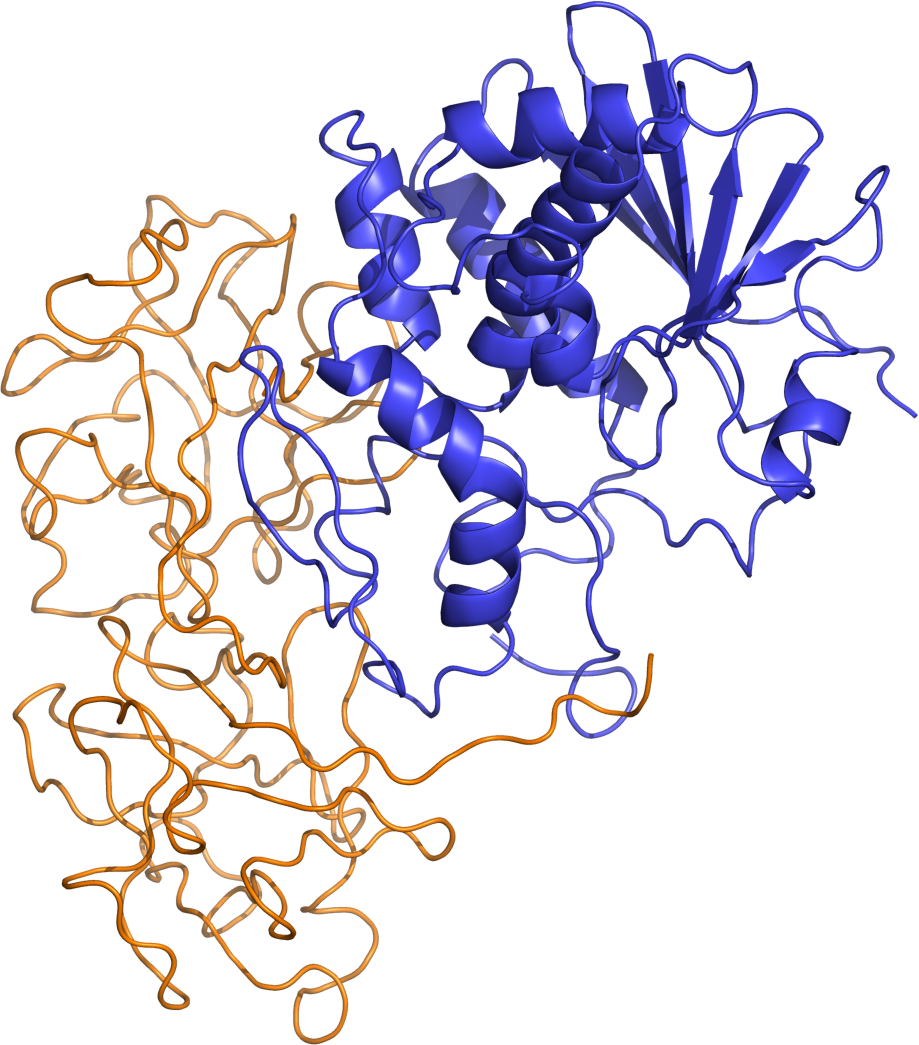
Ricin structure.
Ricin is known as a highly toxic lectin which is naturally occurring. lectinsare one of many types of proteins that can bind to a cell's membrane. Ricin is produced by in the seeds of the castor plant. According to the CDC "the LD50 by intravenous injection is about 5 µg/kg, whereas it is 20 mg/kg by intragasteric route.23,24 The ricin aerosol LD50 for NHP is estimated to be 10-15 µg/kg.17 The human lethal dose has not been established rigorously, but may be as low as 1-5 mg of ricin by injection 25 or by the aerosol route" This shows just how little Ricin is needed to kill a human.
Just some quick backstory on what median lethal dose is means. Median lethal dose its a means to measure how lethal a toxin is. It means that its dose required to kill half the members of a tested population after a specified test duration. LD50 is simply and abbreviation meaning lethal dose 50%. A lower LD50 number means more toxicity. This test was first done in 1927 by J.W. Trevan. The main way to find the LD50 is to simply test the substance on lab rats. The LD50 test can be some what unreliable as the variation is so great between different species' immune system and physiology.
Ricin has been around for some time. according to Globalsecruity.org "During World War I, the United States explored ricin as a potential offensive biological weapons toxin at the American University Experimental Station. Two methods of weaponizing ricin were explored: bullets and shrapnel coated with ricin toxins or a 'dust cloud' of toxin toxins inhaled into the lungs." Recently some terrorist groups have experimented with using ricin as a weapon and caused several incidents of the poisons being mailed to U.S. politicians. For example, A letter containing ricin was allegedly sent to American President Barack Obama at the same time.
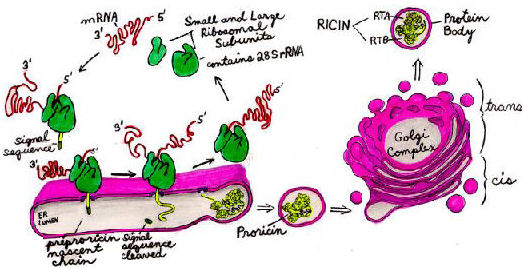
Ricin is extremely toxic if inhaled, injected, or ingested. It kills by slowing or stopping protein synthesis. This means that ricin prevents cells from assembling amino acids into proteins. A Cornell university resource goes much more in-depth about this. According to the Cornell university college of agriculture and life sciences "Ricin inhibits protein sythesis by specifically and irreversibly inactivating eukaryotic ribosomes." It goes on to say "These "ribosome-inactivating proteins" (RIPs) are typically N-glycosylated, 30 kDa monomers (Type 1 RIPs). However, in order to bind to the cell surface galactosides and enter the cytosol to reach ribosomes, they require a second monomer, a galactose-binding, 30 kDa lectin. The monomers are joined by a disulfide bridge to form the toxic heterodimers (Type 2 RIPs)." Here is a diagram showing the life cycle of ricin as it inter acts with the cells.
From the sixth grade until the
eighth grade I had debilitating pain in my abdomen roughly thirty minutes to an
hour after each meal that I ate. In addition to that I was always bloated,
frequently nauseous after I started to eat, and no matter how much I ate I
would lose weight. My doctor was baffled at what it could be and I endured
months of tests--mostly blood work--and doctor’s appointments before he finally
figured it out: my stomach was riddled with the bacteria Helicobacter Pylori
(H. pylori).
About half of the world's
population is actually infected with this bacteria, but most people do not have
any symptoms or have any problems linked with H. pylori. In addition to the symptoms
that I experienced, one could possibly encounter a loss of appetite or frequent
burping. The complications of H. pylori
are far worse than the pain in the abdomen (and it is
not easy pain). H. pylori
can lead to an inflammation of the lining of the stomach due to irritation,
ulcers, or stomach cancer. Roughly one in ten people with H. pylori develop an
ulcer.
When someone comes into the
doctor's office with the symptoms of H. pylori, there are several ways that
they can be tested for the bacteria. I was diagnosed by a blood test, which is
the least accurate way of determining active H. pylori. A blood test simply
tests whether or not there are antibodies for H. pylori, which would appear to
be positive even if that strand of H. pylori was not harmful or the body had
already defeated it. Another option is
testing the breath after taking medication that would give off carbon if in the
presence of H. pylori. Certain medicines in your system can affect the validity
of the breath test, though. Fecal matter can be tested for antigens that would
lead the doctor to the conclusion that H. pylori is present, but the same
medicines can affect this test. Lastly, the doctor can sedate the patient and
perform an endoscopy exam which involves putting a long tube down the patient's
throat with a camera on the end to view the inside of the stomach and to take a
biopsy of the tissue to test for H. pylori directly. However, due the invasive
nature of this test, it is typically reserved for diagnosing ulcers associated
with H. pylori or in a last effort to definitively rule out other
conditions.
Once diagnosed, the treatment for
H. pylori is fairly simple. The doctor will typically prescribe two types of antibiotics
because of the resilience of the bacteria and its ability to develop a
resistance to the antibiotic. On top of that, doctors give medication designed
to block acid in the stomach in order to start the healing process of the
stomach lining. There are several options for acid blockers such as proton pump
inhibitors (ex: Prevacid), histamine blockers (ex: Zantax), or bismuth
subsalicylate (ex: Pepto-Bismol). With the resilience of this bacteria, it is
also important that the patient is tested at least a month after treatment has
ended to see if another round of antibiotics are necessary.
All of the information dealing with
the treatment of ulcers caused by H. pylori can be attributed to Dr. Barry
Marshall. In the 1980s, it was thought that ulcers were caused by stress but
Marshall knew that was not true—he knew that they were caused by H. pylori.
After seeing patient after patient die from severe ulcers that were not caused
by stress, he knew that he had to do something about it. The bacteria would not
grow in lab mice to be tested, so he infected himself with a very bad strain of
H. pylori to see if it would give him an ulcer and then if he could treat it.
It is because of this man’s devotion to the health of his patients and this courageous
experiment that H. pylori has become severely less deadly and highly treatable.